Meeting Tuesday, Sept 3rd
Welcome back! I hope everyone had a great summer. Our first meeting of the semester will be next Tuesday the 3rd from 4pm-6pm in MCS 101. We should have nice weather that day so we will get out the solar telescope and (safely) look at the sun.
Officer Elections
We will also hold officer elections. We need at least two more officers of the club due to Dee graduating and my stepping down as president due to time constraints. It's a great time to become an officer because last year we were able to secure funding for the club, so you wont be starting from scratch in that area.
New Members
If you're receiving this because you signed up for the club at the Howell Hall BBQ last week, I thank you for your interest and hope to see you at a meeting! I want to reiterate that there are no prerequisites for joining the club. You don't have to be a STEM major or know anything at all about astronomy. All you need to bring is a love for space!
Astronomy News
It's been a busy week for astronomy news. We've got news on the detection (or not) of dark matter, newly discovered rogue worlds, as well as new advances in our ability to image black holes. All three of these stories were posted in just the last day.
Astronomers and Physicists have been puzzling over ways to experimentally observe dark matter since the term was first coined in 1933. Despite our efforts, our best evidence for the existence of dark matter is that we have no other explanation for how certain galaxies are able to stay together and not fly apart from the outward force caused by their rotation. According to our best understanding of gravity, there simply isn't enough visible matter there for them to stay together.
Researchers at the Lawrence Berkeley National Laboratory (who visited UCO last year for a recruitment event) have just completed an experiment whose results suggest that we have significantly narrowed down the possibilities for what we thought dark matter is made of. This was done using a sensor almost a mile underground in South Dakota. As we keep crossing things off the list and still have no explanation for dark matter, it begs the question of if dark matter actually exists the way we've previously thought.
A minority of astrophysicists work on the idea of MOND (Modified Newtonian Dynamics), which suggests that our understanding of gravity is incomplete, and that the behavior of galaxies can be explained without the existence of dark matter by tweaking our mathematical theories of gravity.
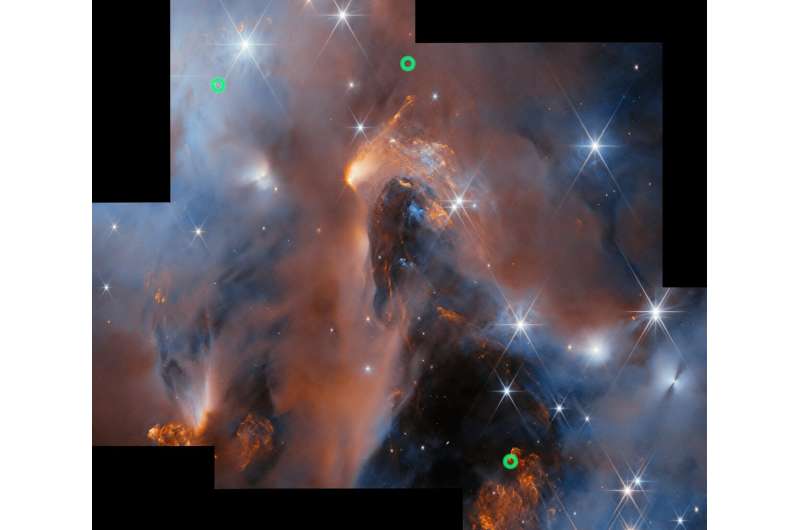
The James Webb Space Telescope has imaged 6 probable rogue worlds, which are objects that are like planets, but are free from any star's gravity so they do not orbit a star like planets do. These discoveries help astrophysicists understand how stars and planets form. Three of the rogue worlds are circled in green.
 Event Horizon Telescope, which is the term for a combination of several telescopes across the globe that we used to take the first ever picture of the accretion disk around a black hole. The major breakthrough they just announced is the ability to observe in so much more resolution that we will be able to extract color information from those images. Visit the link to see simulated images of what that may look like.
Have a great week, and I'll see you at the meeting!
Tyler Garcia
|
|
|
|


